
I’ve always been a bit bemused by the story In the Old Testament with Caleb and his daughter. Did you know it’s apparently so important it’s mentioned twice? Caleb gives her land as a marriage gift. This isn’t a dowry. It’s something he gives directly to her. She takes ownership, then returns to boldly make a request–streams of water. Caleb responds with extravagance, giving her both the lower and the upper streams.
What does that feel like, to come with such confidence and strength before a good and loving father?
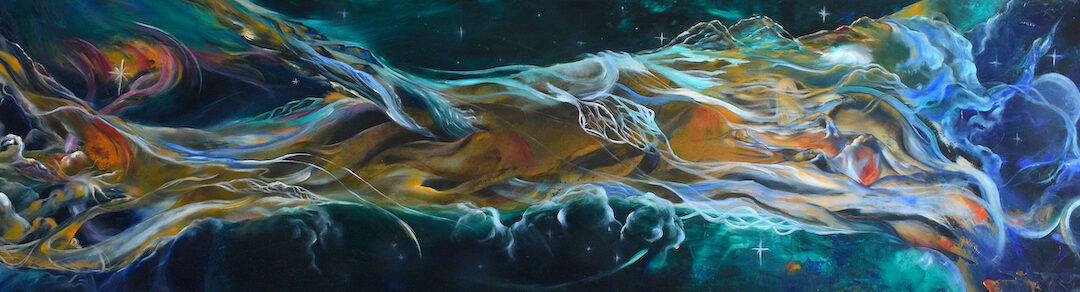
It’s a question I’ve asked myself over the years, and as I painted this piece, I was overwhelmed by the Holy Spirit. We can all know the security and deep acceptance of being a child wholly loved and accepted by our Heavenly Father. It’s there for us, if we can just receive it.
There is an elegant parallel in all of this to Jesus and the Woman at the Well. In this story, it is Jesus who requests water. Just as she suffers, we see Christ entering into her suffering, experiencing distress in His physical body. He moves towards her trauma and pain with kindness and compassion, calling her to receive the Living Water. He promises to meet her needs with abundance. Even where he names her sins, there is no religious piety and self-righteous judgment. Only acceptance and an invitation to enter into something more. Something better.
Woven throughout Scripture is this recurring theme of water and thirst. This painting is a meditation on these stories and explores what it means to draw near to God with boldness and the assurance He will not turn away. It also serves as a visual invitation for all who are thirsty to join the cosmic journey and grand narrative, where streams of water flow even in the desert, bringing love and safety.
Turn your phone or tilt your head and you’ll see that when viewed vertically, the foundation of the painting is a fig tree. What else can you see in this painting?